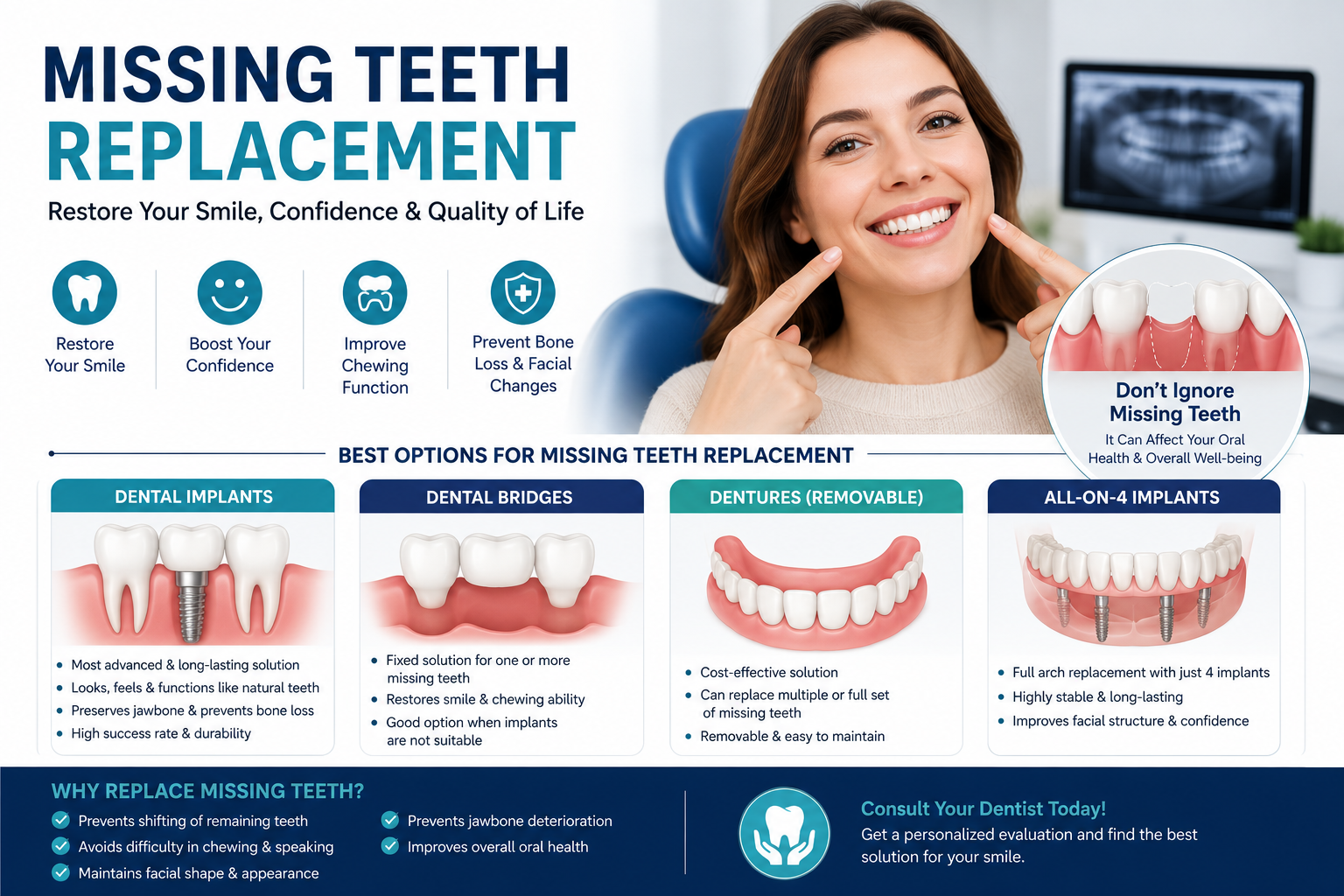
Missing Teeth Replacement: Best Options to Restore Your Smile and Oral Health
Introduction
Missing teeth can affect much more than your appearance. They can impact your ability to chew food properly, speak clearly, and maintain good oral health. Whether you have lost a tooth due to injury, gum disease, tooth decay, or aging, modern dentistry offers several effective solutions to restore your smile.
Replacing missing teeth is not just a cosmetic procedure. It helps preserve jawbone health, prevents neighboring teeth from shifting, and improves overall quality of life.
In this guide, we’ll explore the causes of tooth loss, the consequences of leaving missing teeth untreated, and the best tooth replacement options available today.
Why Replacing Missing Teeth Is Important
Many people assume that losing one tooth is not a major problem. However, even a single missing tooth can lead to long-term dental issues.
Prevents Teeth Shifting
When a tooth is lost, neighboring teeth may gradually move into the empty space, causing misalignment.
Maintains Jawbone Health
Natural tooth roots stimulate the jawbone. Without stimulation, bone loss can occur over time.
Improves Chewing Ability
Missing teeth can make it difficult to chew certain foods properly.
Enhances Appearance
A complete smile boosts confidence and facial aesthetics.
Supports Clear Speech
Teeth play an important role in pronunciation and speech clarity.
Common Causes of Tooth Loss
Several factors can lead to missing teeth.
Severe Tooth Decay
Untreated cavities can destroy a tooth beyond repair.
Gum Disease
Advanced periodontal disease is one of the leading causes of tooth loss in adults.
Dental Trauma
Accidents, sports injuries, and falls can result in tooth loss.
Aging
Over time, dental problems may increase if oral hygiene is neglected.
Genetic Factors
Some individuals are naturally more prone to dental issues.
Consequences of Untreated Missing Teeth
Ignoring missing teeth can create additional oral health complications.
Bone Loss in the Jaw
The jawbone begins shrinking after tooth loss.
Bite Problems
Changes in tooth alignment can affect the bite.
Difficulty Eating
Chewing efficiency decreases significantly.
Facial Changes
Tooth loss can contribute to a sunken facial appearance.
Increased Risk of Further Tooth Loss
Shifting teeth become harder to clean, increasing decay risk.
Best Missing Teeth Replacement Options
Modern dentistry provides multiple solutions based on individual needs, budget, and oral health conditions.
1. Dental Implants
What Are Dental Implants?
Dental implants are artificial tooth roots made from titanium that are surgically placed into the jawbone.
A custom crown is attached to the implant, creating a natural-looking replacement tooth.
Benefits of Dental Implants
- Permanent solution
- Natural appearance
- Prevents bone loss
- High success rate
- Functions like natural teeth
- Long-lasting durability
Ideal Candidates
- Healthy gums
- Adequate jawbone density
- Good overall health
Lifespan
With proper care, dental implants can last 20 years or longer.
2. Dental Bridges
What Is a Dental Bridge?
A dental bridge fills the gap created by one or more missing teeth.
The bridge is supported by adjacent natural teeth or implants.
Benefits of Dental Bridges
- Faster treatment process
- Fixed and non-removable
- Restores chewing ability
- Natural appearance
Limitations
- Adjacent teeth may need reshaping
- Does not prevent bone loss underneath the missing tooth
Lifespan
Typically 10–15 years with proper maintenance.
3. Dentures
What Are Dentures?
Dentures are removable prosthetic devices used to replace multiple missing teeth.
Types of Dentures
Partial Dentures
Used when some natural teeth remain.
Complete Dentures
Used when all teeth are missing.
Benefits
- Affordable solution
- Suitable for multiple missing teeth
- Non-surgical option
Limitations
- May require adjustments
- Less stable than implants
- Bone loss may continue over time
4. Implant-Supported Dentures
This option combines the benefits of implants and dentures.
Dental implants are placed in the jawbone to support a denture securely.
Benefits
- Greater stability
- Improved chewing efficiency
- Reduced movement while speaking
- Better comfort than traditional dentures
5. All-on-4 Dental Implants
What Is All-on-4?
All-on-4 is an advanced implant technique that uses four strategically placed implants to support a full arch of replacement teeth.
Advantages
- Full-mouth restoration
- Fewer implants required
- Improved stability
- Faster treatment compared to traditional full-mouth implants
Best For
Patients missing most or all teeth in one arch.
Dental Implants vs Bridges vs Dentures
| Feature | Dental Implants | Dental Bridges | Dentures |
|---|---|---|---|
| Appearance | Excellent | Excellent | Good |
| Stability | Excellent | Very Good | Moderate |
| Bone Preservation | Yes | No | No |
| Longevity | 20+ Years | 10–15 Years | 5–10 Years |
| Maintenance | Easy | Easy | Moderate |
| Cost | Higher | Moderate | Lower |
How to Choose the Best Tooth Replacement Option
The right solution depends on several factors.
Number of Missing Teeth
Single tooth loss may benefit from an implant or bridge.
Jawbone Condition
Bone density affects implant eligibility.
Budget
Different treatment options vary in cost.
Oral Health Status
Healthy gums are essential for successful treatment.
Personal Preferences
Some patients prefer fixed solutions while others choose removable options.
Caring for Replacement Teeth
Proper maintenance helps maximize the lifespan of dental restorations.
Brush Twice Daily
Use a soft-bristled toothbrush.
Floss Regularly
Clean around replacement teeth carefully.
Visit Your Dentist Regularly
Routine checkups help identify problems early.
Avoid Smoking
Smoking can negatively affect implant success and oral health.
Wear a Night Guard if Needed
Protect restorations from grinding damage.
Frequently Asked Questions (FAQs)
What is the best replacement for a missing tooth?
Dental implants are generally considered the most effective long-term solution because they closely mimic natural teeth.
Can a missing tooth be replaced years later?
Yes. Many patients successfully replace teeth years after tooth loss.
Are dental implants painful?
Most patients report minimal discomfort during and after the procedure.
How long do dental implants last?
With proper care, they can last decades and often a lifetime.
Is replacing one missing tooth necessary?
Yes. Even one missing tooth can affect alignment, chewing, and bone health.
Conclusion
Missing teeth can significantly impact oral health, confidence, and quality of life. Fortunately, modern dentistry offers highly effective solutions including dental implants, bridges, dentures, and All-on-4 restorations. Early treatment helps prevent bone loss, maintains facial structure, and restores full dental function.
If you have one or more missing teeth, consulting a qualified dentist can help determine the best treatment option for your specific needs and goals